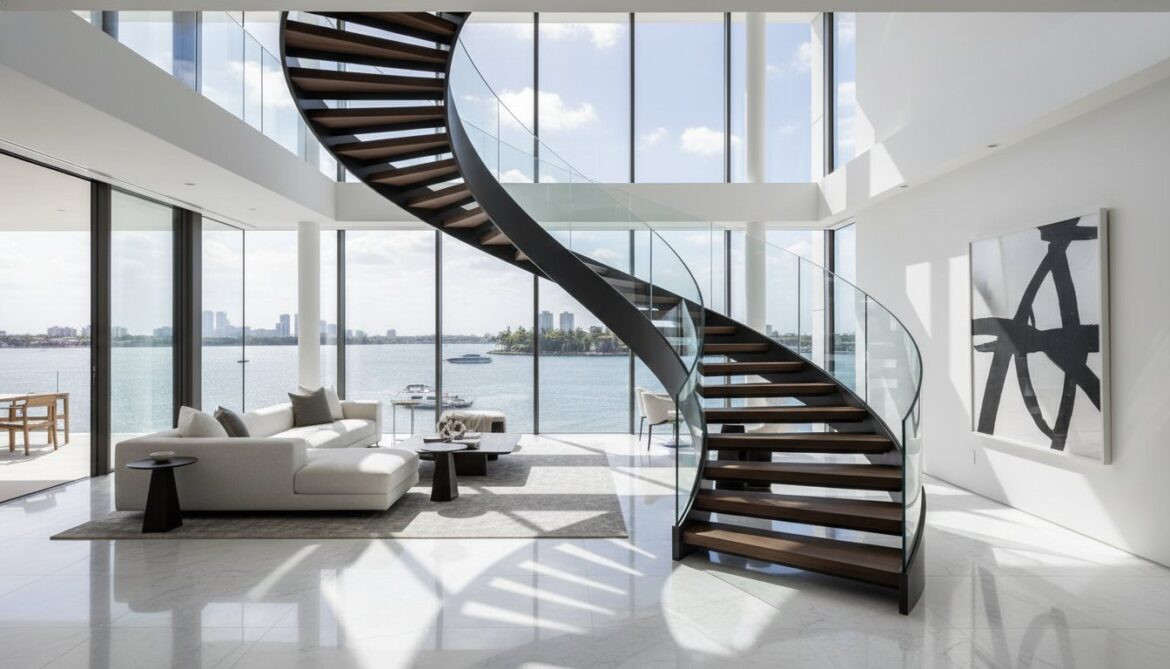
Spiral vs Helical Stairs in Miami: The Architect’s Guide to Curved Design
Article by
Linerep Solutions
A staircase is never just a transition between floors; in a high-end Miami residence, it's the structural heartbeat of the home. You recognize that a curved design adds immediate architectural value, yet the nuanced terminology often leads to costly confusion during the design phase. Choosing a configuration that feels cramped or fails to meet the Florida Building Code 8th Edition, which has been in effect since December 31, 2023, is a risk no visionary homeowner should take. Precision is the only path to a flawless result.
This guide clarifies the spiral vs helical stairs debate, ensuring your selection aligns with your aesthetic vision and the technical requirements for modern Florida living. We'll explore the critical "Post vs. Void" distinction and how bespoke engineering transforms a simple means of egress into a sculptural sanctuary. You'll gain the confidence to select a statement piece that elevates your property's value while adhering to every stringent safety standard. From material selection to the final installation, we'll detail how form meets function in the most exclusive residences.
Key Takeaways
Master the "Post vs. Void" distinction to choose between the compact efficiency of a spiral and the grand, sculptural presence of a helical design.
Learn why the footprint of spiral vs helical stairs dictates the architectural flow of your open-concept living space in Miami, Orlando, or Tampa.
Gain clarity on Florida Building Code 8th Edition requirements to ensure your statement piece meets all safety and egress standards for high-end residential projects.
Explore how precision-engineered monobeam systems allow for seamless, sweeping curves that maintain structural integrity without a central support column.
Discover the value of a template-free, bespoke fabrication process that ensures your staircase is a unique architectural investment rather than a generic fixture.
Table of Contents
The Geometry of Elegance: Defining Spiral vs. Helical Stairs in Miami
Engineering the Curve: Structural Integrity and Materiality in Orlando
Space, Flow, and Florida Building Codes in Tampa
Elevating Your Vision in Miami, Orlando, and Tampa
The Geometry of Elegance: Defining Spiral vs. Helical Stairs in Miami
True architectural distinction begins with geometry. While both designs utilize curvature to create drama, the structural logic of The Geometry of Elegance: Defining Spiral vs. Helical Stairs depends entirely on the presence of a central axis. A spiral staircase is defined by treads that radiate from a single, central support column. It's a masterpiece of compact efficiency. In contrast, a helical staircase follows a circular path around a central "void" without any central post. The difference is subtle in theory but transformative in practice.
To better understand these structural concepts, watch this helpful video comparing the two designs:
Architects in South Florida often use the terms "circular" and "curved" to describe these high-end systems. Helical designs offer a more fluid, flowing aesthetic often compared to the double helix of DNA. This open-concept approach removes visual barriers. It transforms a functional necessity into a transparent statement piece. In the context of high-end architecture, the distinction between these forms is vital for both aesthetic flow and code compliance. Circular stairs usually have a larger radius than spirals, making them more comfortable for daily use in primary living areas.
The "Post vs. Void" Test
The central post is the defining structural anchor of a true spiral. It provides the primary load-bearing support for every tread. This creates a tight, disciplined footprint. It's an ideal choice for secondary egress or loft access where square footage is at a premium. Helical stairs, however, rely on double-stringer systems or bespoke mono-beam staircase design to maintain their shape. They don't need a central anchor. The "void" at the center creates a sense of architectural weightlessness. It allows light to pass through the center of the curve. This openness is why helical designs are favored in grand foyers where the spiral vs helical stairs decision impacts the entire floor plan. The helical void stands as the pinnacle of modern staircase engineering, where structural precision meets pure aesthetic minimalism.
Engineering the Curve: Structural Integrity and Materiality in Orlando
Engineering a curve requires a departure from standard construction. While a spiral relies on the compression of a central pillar, a helical system distributes weight through its perimeter. This structural choice impacts everything from the feel underfoot to the long-term durability of the home. Precision fabrication is non-negotiable. Without it, curved systems suffer from micro-vibrations that betray the luxury aesthetic. Every weld and joint must be flawless to ensure a permanent, silent ascent.
The choice of spiral vs helical stairs also dictates material behavior. Timber treads in a spiral layout are often smaller, radiating from the center. In a helical design, larger timber or stone slabs require a robust support system to prevent deflection. When navigating Florida Building Codes, engineering for these loads is paramount. High-end residential projects often demand stone treads that weigh several hundred pounds. Supporting this mass without a central post requires technical mastery and advanced structural engineering. Modern helical stairs achieve this through precision-engineered steel spines that eliminate visual clutter while maintaining the structural integrity demanded by Florida's coastal environments.
The Mono-Beam Advantage in Helical Design
A bespoke mono-beam staircase design represents the ultimate in minimalist engineering. By utilizing a single, concealed steel spine, we achieve a floating effect that traditional double-stringer systems cannot replicate. This allows for the integration of luxury staircase materials like structural glass or massive stone treads without visible bulk. It is a seamless marriage of art and industry. Built to last. Trusted execution.
Balustrades and Railings: Framing the Vision
Railings for helical systems demand extreme precision. Crafting curved, structural glass balustrades requires heat-soaking and exact radius measurements. Spiral railings are often more restrictive, following the tight diameter of the central post. Helical designs offer the freedom to use continuous, sweeping handrails that guide the eye upward. If you are ready to refine your home's architecture, you can speak with a staircase specialist to discuss the technical feasibility of your vision.

Space, Flow, and Florida Building Codes in Tampa
Spatial dynamics dictate the atmosphere of a luxury interior. In the expansive floor plans common in Tampa and Fort Lauderdale, the footprint of spiral vs helical stairs becomes a critical design lever. A spiral staircase offers a compact, vertical transition, whereas a helical design requires a larger radius to facilitate its sweeping arc. This extra space allows for a more ergonomic "walking line." It transforms a simple climb into a graceful experience. In the high-end market, this ease of movement is a marker of premium architectural quality that significantly impacts property valuation.
Navigating the Florida Building Code, 8th Edition (2023) is a prerequisite for any new build. Since its adoption on December 31, 2023, the code has enforced specific metrics for curved stairways to ensure safety. For instance, treads must maintain a minimum depth of 7.5 inches at a point 12 inches from the narrow edge. Citing Engineering the Curve: Structural Integrity and Materiality helps clarify how these geometric constraints interact with structural demands. At Marbella Stairs, we ensure every design is engineered to code from the first draft, preventing costly delays during the permitting phase.
Egress Requirements for Florida Residential Projects
Code compliance dictates the utility of your staircase. In many Florida jurisdictions, a spiral staircase is permitted as a primary means of egress only within limited square footage or for specific loft access. For grander applications, a helical design is often the superior choice. Its wider tread depth at the walking line meets primary egress standards more easily. This makes it the preferred foundation for a high-impact curved staircase entry that serves as the home's main thoroughfare.
Optimizing the Open-Concept Floor Plan
A helical staircase functions as a central sculptural element in modern waterfront homes. It anchors the open-concept plan. By utilizing a void center, you create sightlines that extend through the staircase itself. This transparency is essential for maintaining a sense of scale in luxury interiors. Strategic placement allows the curve to frame views of the skyline or lush tropical landscapes. If you are navigating these complex design and code requirements, Discuss your project with our engineering team to ensure a flawless execution.
Elevating Your Vision in Miami, Orlando, and Tampa
Miami's architectural identity is defined by a relentless pursuit of the avant-garde. In this environment, a generic solution isn't just a choice; it's a compromise. Our approach to bespoke staircase project management eliminates the standard templates found in mass-market construction. We operate with a philosophy of absolute uniqueness. No shortcuts. No compromises. Every project begins with a deep collaboration with local Miami architects to ensure that the structural feasibility of your spiral vs helical stairs selection is confirmed long before fabrication begins.
We bridge the gap between visionary design and technical reality. From the initial 3D visualization to the final on-site assembly in Tampa or Fort Lauderdale, our team manages every variable. This end-to-end oversight is essential for maintaining the integrity of the design, especially when navigating the spatial complexities of spiral vs helical stairs in open-concept layouts. A custom-engineered architectural statement piece is more than a utility. It is a premium investment that anchors the property's market value, often serving as the primary visual anchor in high-value waterfront listings. Precision fabrication ensures the finished product is as durable as it is beautiful. Built to endure.
Custom Fabrication for Florida's High-End Interiors
The future of Florida luxury resides in the intersection of art and industry. We specialize in luxury floating stairs and complex helical systems that challenge traditional boundaries. Our commitment to precision engineering ensures that every tread and balustrade is built to last. We focus on the granular details that define a high-end sanctuary. Flawless execution. Trusted results. Every curve we fabricate is a testament to the marriage of form and function. If you are ready to transform your physical space, Speak with a staircase specialist to discuss your bespoke project and begin the journey of architectural elevation.
Designing Your Architectural Signature
The choice between spiral vs helical stairs is ultimately a decision of spatial intent. One configuration prioritizes disciplined efficiency; the other creates a grand, sweeping sculptural presence that anchors an open-concept floor plan. Both designs require the technical mastery of a bespoke specialist to ensure absolute compliance with the Florida Building Code 8th Edition, which has been in effect since December 31, 2023. Precision engineering is the only path to eliminate micro-vibrations and achieve a truly weightless, floating aesthetic in your home.
Marbella Stairs serves the exclusive residential markets of Miami, Orlando, Tampa, and Fort Lauderdale. We are bespoke mono-beam and helical specialists dedicated to permanence and flawless execution. Our team coordinates every detail with your architect to ensure structural feasibility in Florida's unique coastal environments. We believe your staircase should be a timeless sanctuary. Built to last. Trusted execution. Precision where form meets function.
Request a design consultation for your Florida project to begin the transformation of your home. Elevation is a standard, not an option.
Frequently Asked Questions
Is a helical staircase safer than a spiral staircase?
Helical staircases offer a higher safety profile because they provide a uniform tread depth along the walking line. Unlike spiral designs, which have treads that taper sharply toward a central post, a helical path allows for a natural, consistent gait. This geometry reduces the risk of missteps. The addition of dual balustrades on both sides of the curve further enhances stability and comfort for every user.
Do helical stairs take up more space than spiral stairs?
Helical stairs require significantly more square footage than their spiral counterparts. A spiral staircase is the ultimate solution for compact efficiency, often fitting within a five-foot diameter. In contrast, a helical design needs a wider radius to maintain its sweeping "void" center. This makes it a preferred choice for grand foyers where the spiral vs helical stairs decision is driven by architectural impact rather than space conservation.
Can a spiral staircase be used as the main stairs in a Florida home?
A spiral staircase can only serve as the primary means of egress in a Florida home under specific conditions defined by the Florida Building Code 8th Edition. Generally, these compact systems are relegated to secondary access for lofts or private balconies. For the main thoroughfare of a luxury residence, a helical design is the standard. It meets the minimum tread and width requirements for primary egress more effectively.
What materials are best for a modern helical staircase in Miami?
Modern helical designs in Miami thrive on materials that maximize transparency and light. Structural glass balustrades paired with white oak or premium stone treads are popular choices for contemporary waterfront estates. Stainless steel mono-beams provide the necessary structural integrity while maintaining a minimalist profile. These materials ensure the staircase remains a timeless statement piece that complements a high-end sanctuary. Explore how modern helical stairs in Miami and Orlando achieve this sculptural elevation through bespoke engineering and precision fabrication.
How much more does a helical staircase cost compared to a spiral?
Helical staircases represent a more significant premium investment than spiral systems. While a standard spiral installation might range from $3,000 to $15,000 based on 2026 national averages, custom helical engineering often starts at $20,000. The increased cost reflects the complexity of the "void" design, the precision fabrication of curved stringers, and the specialized labor required for a post-free installation. Choosing between spiral vs helical stairs is a balance of budget and architectural vision.
